
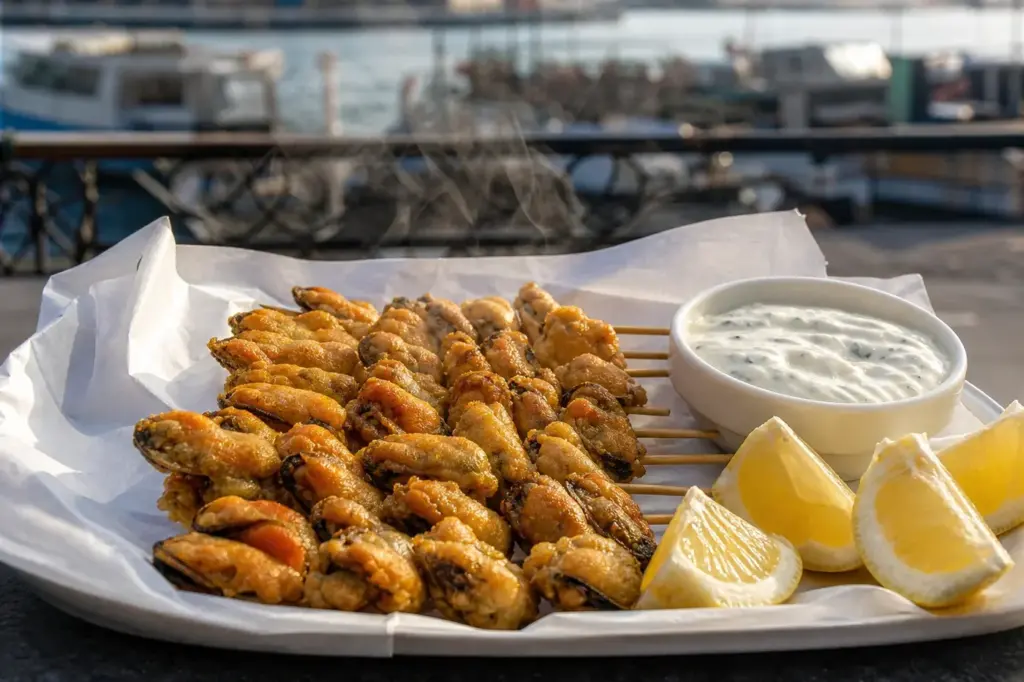
Fried mussels, or midye tava, are one of Istanbul’s most iconic street snacks. This guide shows you how to make them at home with the authentic tarator dipping sauce. If you’re looking to recreate this beloved Istanbul street food, the recommended approach is to use fresh mussels, a light beer or club soda batter, and proper deep-frying technique.
The dish appears simple: mussels threaded on skewers, dipped in batter, and fried until golden. But the key to success lies in drying the mussels thoroughly before battering and maintaining the right oil temperature. This guide covers ingredient selection, step-by-step preparation, and how to make the traditional tarator sauce that makes this dish unforgettable.
Quick answer: Clean and steam fresh mussels, remove from shells, and pat dry. Prepare a light batter using flour, cornstarch, baking powder, salt, pepper, and cold water. Dip mussels in batter and deep-fry at around 180°C until golden brown (3–5 minutes). Serve immediately with tarator sauce made from yogurt, walnuts, bread, garlic, and lemon. Total time: 40–50 minutes.
At a Glance
| Type | Street food & snacks |
|---|---|
| Origin | Istanbul, Turkey |
| Servings | 4 servings |
| Total time | 40–50 minutes |
| Difficulty | Medium |
History and Story of Fried Mussels (Midye Tava)
Fried mussels have been part of Istanbul street food culture for generations. While mussels appear in Ottoman palace cuisine in dishes such as mussel-stuffed cabbage, it was Istanbul’s coastal communities that popularized simple, everyday mussel preparations. Fried mussels and stuffed mussels (midye dolma) emerged as icons of Turkish street food, particularly common in seaside neighborhoods where fresh mussels were abundant and affordable.
Ingredients
- 500 g fresh mussels, scrubbed and debearded
- 0.5 cup all-purpose flour
- 2 tablespoons cornstarch
- 0.5 teaspoon baking powder
- 0.5 teaspoon salt
- 0.25 teaspoon black pepper
- 0.75 cup cold water
- Vegetable oil for deep frying (approximately 1 litre)
- 0.75 cup plain yogurt
- 0.5 cup crushed walnuts
- 2 slices stale bread, crusts removed
- 2 cloves garlic, minced
- 2 tablespoons lemon juice
- 2 tablespoons olive oil
- Salt for tarator sauce
How Fried Mussels (Midye Tava) Is Made
Step 1: Clean and prepare the mussels
Scrub the mussels under cold running water to remove dirt. Pull away the beard (the thread-like filament) from each mussel. Discard any mussels that are open or do not close when tapped. Place cleaned mussels in a pot with a splash of water.
Tip: Clean mussels just before cooking to keep them fresh.
Step 2: Steam the mussels open
Cover the pot and heat over medium-high until the mussels open, about 3–5 minutes. Discard any mussels that do not open. Remove mussels from their shells and place in a colander. Reserve a small amount of the steaming liquid if needed later.
Tip: Do not overcook; steaming is just to open them, not to cook them fully.
Step 3: Dry the mussels thoroughly
Spread the cooked mussels on paper towels or a clean cloth. Pat them dry carefully with additional paper towels. Moisture on the surface will prevent the batter from adhering properly and make the fried result less crispy.
Tip: Well-dried mussels are essential for a crisp, golden coating.
Step 4: Prepare the batter
In a medium bowl, whisk together all-purpose flour, cornstarch, baking powder, salt, and black pepper. Gradually add cold water, whisking until smooth. The batter should be thin enough to coat mussels lightly but thick enough to cling.
Tip: Use cold water to make the batter lighter and more airy, which creates a crispier crust.
Step 5: Heat the oil
Pour vegetable oil into a deep pan or pot to about 2–3 inches deep. Heat the oil to approximately 180°C (350°F). Test with a small piece of bread; it should sizzle and brown in a few seconds.
Tip: Use a thermometer for accuracy. Oil that is too cool will absorb into the batter; oil that is too hot will burn it.
Step 6: Fry the mussels
Thread 3–4 dried mussels onto small wooden skewers. Dip each skewer into the batter, turning to coat all mussels evenly. Carefully place into the hot oil. Fry for 3–5 minutes, turning occasionally with tongs, until the coating is golden brown and crispy on all sides.
Tip: Do not overcrowd the pan; fry in small batches so the temperature stays consistent.
Step 7: Prepare the tarator sauce
While mussels fry, combine yogurt, crushed walnuts, stale bread (crumbled or torn into pieces), minced garlic, lemon juice, olive oil, and a pinch of salt in a food processor. Blend until smooth and creamy, adjusting consistency with a little water if needed.
Tip: Make tarator sauce a few minutes ahead so it is ready to serve immediately.
Step 8: Drain and serve
Remove fried mussels from oil with a slotted spoon and place on paper towels to absorb excess oil. Sprinkle lightly with salt while still warm. Serve immediately on the skewers with a bowl of tarator sauce for dipping, and lemon wedges on the side.
Tip: Fried mussels are best eaten immediately while the coating is still crisp.
Variants
- Midye dolma (stuffed mussels): Mussels filled with spiced rice, pine nuts, and currants, then steamed. A different texture and flavor profile from the fried version.
- Fried mussels in bread: Instead of serving on a stick, some vendors place fried mussels inside a long, thin bread roll for a sandwich-style serving.
- With different dipping sauces: While tarator sauce is traditional, some vendors serve fried mussels with garlic yogurt sauce or simply with lemon juice.
- Fried shrimp: The same batter and frying technique applied to shrimp instead of mussels, often sold from the same vendors.
Common Mistakes to Avoid
- Skipping the steaming step or using raw mussels: This makes them difficult to remove from shells and can leave them undercooked. Steam them just long enough to open, 3–5 minutes.
- Not drying mussels before battering: Wet mussels will cause the batter to slide off or become soggy. Pat them thoroughly dry with paper towels.
- Using warm water in the batter: Warm water creates dense, heavy batter. Always use cold water for a light, airy coating.
- Overcrowding the pan while frying: Cooking too many mussels at once drops the oil temperature, resulting in greasy instead of crispy mussels. Fry in small batches.
- Frying at incorrect temperature: Oil that is too cool absorbs into the coating; oil that is too hot burns it. Use a thermometer and aim for 180°C (350°F).
- Not serving immediately: Fried mussels lose their crispness quickly. Serve right away while the coating is at its best.
- Over-processing the tarator: If blended too long, tarator becomes thin and watery. Pulse just until smooth and creamy.
How to Order and Eat It
Fried mussels are typically served on wooden skewers. Hold the skewer and dip each mussel into the tarator sauce or squeeze fresh lemon juice over it before eating. The mussel should slide easily off the skewer if properly cooked. Eat while hot and crispy. In some areas, vendors also serve them inside a split bread roll as a sandwich, which you can eat with your hands. A cold beer is a traditional accompaniment.
To order: Bir kişilik midye tava, lütfen. [One serving of fried mussels, please.]
Diet and Allergens
- Contains gluten
- Contains molluscs
- Contains nuts
Istanbul Vibes Tips
- Buy mussels from fish markets in the morning when they are freshest. Look for mussels with tightly closed shells and a briny smell of the sea, not ammonia.
- If you cannot find fresh mussels, frozen pre-cooked mussels work well. Thaw them first and pat dry thoroughly before battering.
- Make extra tarator sauce; it keeps in the refrigerator for several days and pairs well with other seafood or as a dip for vegetables.
- Wooden skewers should be soaked in water for at least 30 minutes before use to prevent burning in the hot oil.
- The batter will continue to thicken as it sits. If it becomes too thick while you are frying batches, whisk in a tablespoon of cold water at a time to maintain the right consistency.
- Vegetable oil with a high smoke point works best. Avoid olive oil, which will burn at the required temperature. Sunflower, canola, or peanut oil are good choices.
Where to Find Fried Mussels (Midye Tava) in Istanbul
Related guides
 Midye Dolma: How to Make Turkish Stuffed Mussels at Home
Main image: AI-generated illustration. It may not show the place exactly as it looks.
 Meze: Turkish appetizers, culture and what to order
Main image: AI-generated illustration. It may not show the place exactly as it looks.
 Fish Sandwich: How to Make Istanbul’s Grilled Mackerel Classic
Main image: AI-generated illustration. It may not show the place exactly as it looks.
 Ayran: How to make Turkish yogurt drink at home
Main image: AI-generated illustration. It may not show the place exactly as it looks.
 Turkish Tea: How to Brew and Serve It Like Istanbul Locals
Main image: AI-generated illustration. It may not show the place exactly as it looks.
Browse more: All Food & Drink · All Other
FAQ
Can I use raw mussels instead of steamed ones?
Raw mussels are very difficult to remove from their shells. Steaming for just 3–5 minutes makes shelling easy and also ensures the mussels are partially cooked before battering and frying. Do not skip this step.
What if I cannot find fresh mussels?
Frozen pre-cooked mussels are a good alternative. Thaw them completely and pat them very dry before battering. The result will be slightly different in texture but still delicious.
Why is cold water essential in the batter?
Cold water keeps the batter light and airy, creating a crispy exterior. Warm water makes the batter dense and heavy, resulting in a greasy crust that absorbs too much oil.
Can I make the tarator sauce ahead of time?
Yes. Tarator sauce keeps in a covered container in the refrigerator for up to 3–4 days. You can make it a few hours ahead or even the day before.
How do I know when the oil is hot enough?
Use a cooking thermometer to aim for 180°C (350°F). If you do not have a thermometer, drop a small piece of bread into the oil. It should sizzle immediately and brown in about 3 seconds.
Can I reuse the frying oil?
Yes, you can reuse frying oil 2–3 times for the same type of food. Let it cool completely, strain it through a fine-mesh strainer or cheesecloth to remove crumbs, and store it in an airtight container.
What if my fried mussels are greasy?
Greasy mussels usually mean the oil was not hot enough. Check your temperature with a thermometer and aim for 180°C. Also ensure mussels are thoroughly dried before battering.
Are fried mussels gluten-free?
Traditional fried mussels use wheat flour in both the dredging flour and the batter, making them not gluten-free. You can substitute with gluten-free flour blends, though the texture will differ slightly.
Istanbul Vibes is a one-person project. A coffee keeps it going
Looking for more on this? How to navigate Moscow offline with maps and translation apps (Moscow Vibes)

Take this guide with you
Get a free PDF of this guide to print or read offline: key facts, tips and a map link on a few clean pages.
Report an issue on this page
How we research and update our guides
About this guide: AI assistance and accuracy
This guide is created with the help of AI and is based on official sources where available. Mistakes can still happen. Opening hours, prices, rules and other details are given to the best of our knowledge as of the date shown and can change without notice. It offers general recommendations only, not professional, legal or travel advice. Please confirm important details with the official source before you travel; you are responsible for your own plans and decisions.
* Affiliate link: as an Amazon Associate we earn from qualifying purchases at no extra cost to you.
