
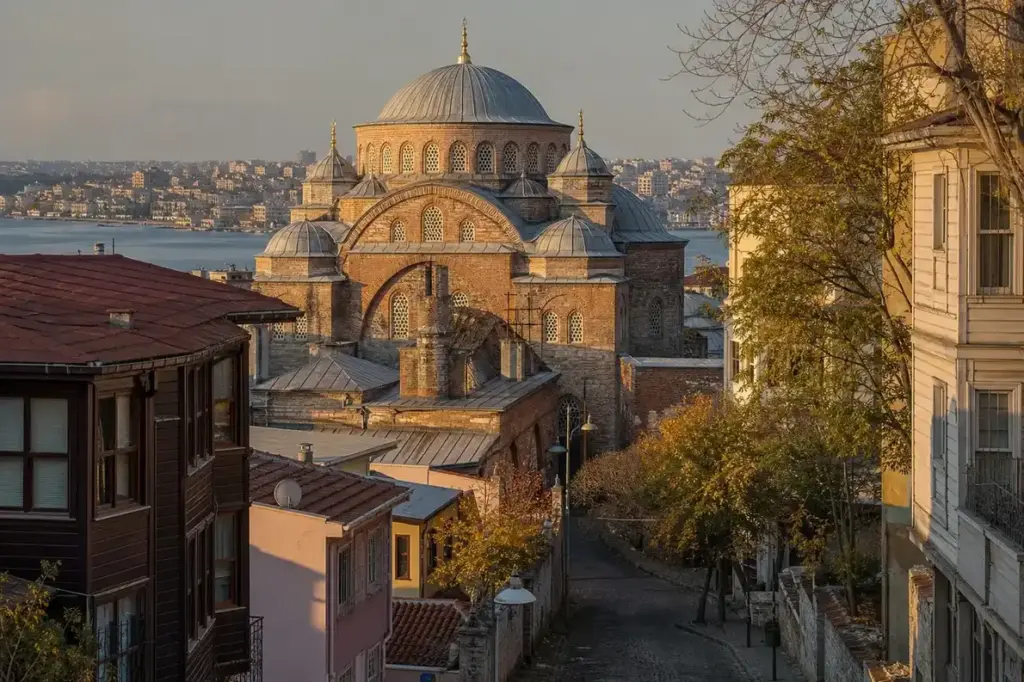
The Gül Mosque is located on the Golden Horn in the Ayakapi neighborhood. This former Byzantine church was converted into a mosque by the Ottomans. The building bridges two faiths and two empires: what locals traditionally called the Church of Saint Theodosia in Byzantine times became known as Gül Camii—the Rose Mosque—after the Ottoman conquest.
Together with Eski Imaret and Vefa Kilise Mosques, it is one of the most important cross-in-square churches in Istanbul. The architecture is austere and impressive, with a single dominant dome, a Greek cross or cross-domed plan oriented northwest-southeast. What you see today reflects both its long Christian past and its five centuries as an active mosque.
Quick Facts
| Built / opened | 11th century (church); 1490 (converted to mosque) |
|---|---|
| Address | Yavuz Sultan Selim, Vakıf Mektebi Sokak No. 16, 34083 Fatih, Istanbul Google MapsApple MapsYandex Maps |
| District | Fatih |
| Admission | Free |
| Best time to visit | Season: Spring (April–May) and autumn (September–October) offer mild weather and fewer summer crowds. Winter is less crowded but can be cold and rainy. Summer (June–August) is warm but attracts more tourists to Istanbul generally.Time of day: Early morning (before 08:30) or late afternoon (after 16:00) is quietest. The afternoon light coming through the high windows is particularly beautiful. Avoid midday and the five prayer times (dawn, noon, afternoon, sunset, evening).Day of the week: Weekdays are quieter than weekends. Friday is the busiest prayer day and the mosque may be closed to tourists during midday prayers. |
What Is (and Isn't) Part of a Visit to Gül Mosque?
| Part | Status | Notes |
|---|---|---|
| Gül Mosque main prayer hall | Included in the standard ticket | Open during visiting hours outside prayer times; free entry. |
| Crypt and basement chambers | Not open to visitors | Not open to visitors; visible only from outside on the eastern facade. |
| Exterior and facades | Included in the standard ticket | Freely accessible at any time; best viewed from the adjacent streets and the Golden Horn side. |
| School of Adile Sultan | Outside / not part of it | A separate Ottoman-era primary school building stands nearby; it is not part of the mosque complex and not open to tourists. |
Why Visit Gül Mosque?
From its imposing position it overlooks the Golden Horn. This is a working mosque, not a museum display—you visit as a guest during visiting hours, which adds authenticity often missing from heavily touristed sites. The building is rarely crowded, and the quiet interior still holds traces of its Byzantine past. There are no Byzantine decorations on the interior walls. They are decorated with 19th century hand-drawn embroidery and “Seal of Solomon” motifs. The neighborhood itself, far from the central tourist bazaars, offers a sense of local Fatih life seldom experienced by visitors.
Highlights of Gül Mosque
The Dome and Interior Layout
A triple archway leads into the tall domed nave, flanked by galleries forming the side arms of the Greek cross, and an apsidal sanctuary at its southeast end. The dome is supported by four solid bases and dominates the interior space. A wooden porch, built in the 1940s, precedes the nave through a wide entry hall, capped with a low barrel vault. Look up at the scale of the dome and the light filtering through the windows.
Tip: Enter through the modern wooden porch—the Byzantine entrance is no longer in use. Dress modestly (cover shoulders and knees) as this is an active mosque.
The Armenian Stone and Eastern Facade
The southwest façade is imposing with its three tall apses that are fitted with blind niches of varying heights featuring ornamental accents. The walls of the basement are exposed to the southeast and east, where the terrain slopes down towards the Golden Horn. The exterior shows the building's age, with brick repairs from Ottoman and later periods visible.
Tip: Walk around the building to see the different facades and the basement level exposed on the east side overlooking the Golden Horn below.
The Name Origin and Legend
The origin of the Turkish name is equally uncertain but is often attributed to a Muslim saint named Gül Baba, the alleged owner of the grave placed inside the southern pier. A popular story claims the church was decorated with roses on May 29, 1453—the feast day of Saint Theodosia and the day the city fell to the Ottomans. When Ottoman soldiers saw the rose petals, they named it the Rose Mosque.
Tip: This legend is debatable—ask the caretaker about both the Gül Baba tradition and the Saint Theodosia story. Both versions are part of the building's cultural memory.
The Gallery and Women's Section
The side galleries have triple archways, but are taller than the entry hall, whereas they share an upper floor with stairs at the southwest end of the entry hall. The level above the entry hall and the right side gallery are used by women and the upper-level of the left side gallery is organized for the Sultan, protected with ornate wooden lattice.
Tip: The lattice screens (mashrabiya) in the upper galleries show the gender-segregated layout typical of Ottoman mosques. These are best seen from the main floor looking up.
Earthquake Repairs and Ottoman Modifications
It was damaged in the earthquake of 1509 and protected temporarily with a wooden roof. During the life of Mimar Sinan, flat domes, windows and side facade arrangements were made in accordance with Turkish architectural style. The Ottoman architect Sinan, one of history's greatest builders, worked on this structure to adapt it for Islamic use.
Tip: The wooden roof you see is a later repair—the original dome was more Byzantine in form. Ottoman modifications are visible in the dome's flat sections and window placements.
The Crypt and Underground Chambers
It is not known if the church was in use after 1453, but its crypt was used as a depot by the Ottomans. The basement level remains largely as it was, with brick-vaulted chambers. Visitors do not typically access the crypt, but you can see the exposed basement walls on the eastern exterior.
Tip: The building sits on the slope of a hill—what appears as the main entrance level is actually elevated above an entire basement. This is unusual and shows the building's original location above a valley.
Atmosphere
The Gül Mosque is quiet and atmospheric, especially compared to the crowded main tourist sites. The visiting hours for Gül Mosque typically follow the daily prayer times, and it may be closed to tourists during these times. Visitors should check the current schedule or inquire locally for the specific hours during their visit. The interior is cool and dimly lit, with the dome overhead creating a sense of enclosure. The smell of old stone and careful cleaning is present. In the afternoon, light angles through the windows and illuminates the interior in golden tones. You will likely see local worshippers preparing for prayers. The caretaker is usually friendly and welcoming to respectful visitors.
History of Gül Mosque
The original name and date of the mosque are contested by scholars. Jules Pargoire, writing at the turn of the century, identifies the building as the Church of Euphemia built during the rule of Basil I (867-886) and argues that it was later consecrated to St. Theodosia, a local saint martyred during iconoclast riots. Hartmut Schafer, based on field studies from the 1960s, proposes a later date of construction between 1000 and 1150 and identifies the church as Christos Euergetes. Scholarship remains divided, but most sources place the original construction in the 10th–11th century.
The church served the Byzantine community for centuries. The building remained a church for about 500 years, and was converted into a mosque after the Ottomans captured Constantinople. After the conquest of Istanbul the church was converted into a mosque in 1499 and took the name “Gül” (English: Rose). Some sources cite 1490 as the conversion date; the exact year remains uncertain.
Ottoman modifications shaped the building’s later form. It was damaged in the earthquake of 1509 and protected temporarily with a wooden roof. During the life of Mimar Sinan, flat domes, windows and side facade arrangements were made in accordance with Turkish architectural style. It was damaged by the Golden Horn fires such as the 1633 Cibalikapı fire. Each repair left its mark, layering Ottoman-era modifications over the original Byzantine structure. The building you see today represents centuries of adaptation.
Legends and Myths about Gül Mosque
The Roses of Saint Theodosia
Legend – historically unreliable. Legend says that when Ottoman soldiers entered the city, they found the old church decorated with roses. It is believed that the reason why the mosque took this name was that the day the city fell on May 29, 1453 coincided with St. Theodosia's feast day, and that's why the church was decorated with flowers. According to this account, the Ottomans named it the Rose Mosque in honor of this coincidence.
The Grave of Gül Baba
Disputed by historians. The origin of the Turkish name is often attributed to a Muslim saint named Gül Baba, the alleged owner of the grave placed inside the southern pier. It is said that "Gül Baba" or the last Byzantine emperor Constantine XI is buried here. The identity of who actually rests inside the building remains uncertain.
Tickets and Booking for Gül Mosque
The Gül Mosque is free to enter during visiting hours outside of the five daily prayers. Check the caretaker’s current schedule before entering, as prayer times shift throughout the year based on sunset. The mosque is typically open from 08:00 to 19:00, but access may be restricted one to two hours before and during each prayer time.
What to bring: Bring a headscarf if you are a woman (spare scarves are sometimes available at the entrance). Remove your shoes before entering the prayer hall—there is usually a rack at the door. Small bags are permitted.
No admission fee applies to Turkish citizens or concessions. Entry is free for all visitors. No official online booking system exists; simply arrive during visiting hours and ask the on-site caretaker for entry.
Suggested itineraries Gül Mosque
1 hour
Enter through the wooden porch and spend 15 minutes in the main prayer hall, looking up at the dome and examining the galleries. Walk around the exterior, including the east side to see the basement level and the Golden Horn view. Speak with the caretaker about the building's history.
1.5–2 hours
Spend 20–30 minutes inside studying the architectural details and reading the inscriptions. Take 10 minutes to sit quietly and observe the atmosphere. Spend 20 minutes walking the perimeter and photographing the exterior facades. Visit the adjacent Adile Sultan School courtyard if accessible. End with tea at a nearby café in the Ayakapi neighborhood.
Half day (3–4 hours with surroundings)
Spend 1.5 hours at the Gül Mosque. Walk down to the Golden Horn waterfront (Cibali area) for 30 minutes to view the mosque from the water level. Return and explore the narrow streets of Ayakapi for an hour. Stop for lunch at a local neighborhood restaurant, then visit the nearby Cibali dock area, which has its own history as a maritime hub.
How to Get to Gül Mosque
By bus: Several bus routes serve the Ayakapi area. From Sultanahmet, take bus 36 or similar routes heading toward Ayvansaray. Get off near Vakıf Mektebi Sokak. Journey time is about 20–30 minutes depending on traffic.
By foot: If you are in Fener or Balat, the Gül Mosque is a 15–20 minute walk downhill toward the Golden Horn. Follow local signs or ask residents for “Gül Camii.”
By taxi or ride-share: The simplest option. Give the driver the address: Yavuz Sultan Selim, Vakıf Mektebi Sokak No. 16, Fatih. Cost is moderate for a short journey within the city.
By ferry and walking: If arriving from the Asian side, take the ferry to Eminönü, then walk or take a short bus ride to the Ayakapi area. The mosque is signposted but not prominently—ask locals.
No metro station is within walking distance. The nearest major transit hub is Eminönü Ferry Terminal (15 minutes away). For travelers using the metro, the M2 line reaches Vezneciler or Sirkeci; from there, transfer to a bus heading toward Fener or Balat, or walk (20–30 minutes).
Accessibility
The Gül Mosque has no ramp access at the main entrance. There are several steps up to the wooden porch and additional steps into the prayer hall. Wheelchair users cannot access the interior. No lift is present. Visitors with mobility difficulties should be aware of the steep approach. There are no designated accessible toilets on-site; the nearest public facilities are in the Eminönü or Fener areas. Benches are not provided inside the mosque for resting.
Food Nearby
The Ayakapi neighborhood is a local residential area, not a tourist dining zone. Simple kebab shops, bakeries, and tea gardens serve the neighborhood along the main streets. Walk toward the Golden Horn waterfront or the Fener district (5–10 minutes away) to find more established restaurants and cafés with better views. The Cibali waterfront has small fish restaurants catering to locals. Bottled water and snacks are available at nearby shops.
What to Bring
Bring a headscarf or lightweight scarf (women are expected to cover their hair; spare scarves are sometimes provided). Wear modest, comfortable walking shoes that you can remove easily—expect steps and uneven flooring. Bring a light layer even in summer, as the stone interior is cool. The neighborhood is quiet and safe, but carry only essentials in a small day bag. No large backpacks are necessary. Bring water, as the building has no café.
Best Views and Photo Spots of Gül Mosque
The Main Dome and Interior Looking Up
Stand in the center of the prayer hall and photograph straight up at the dome. The light streaming through the windows illuminates the dome's curve and supporting arches. This captures the scale and architectural drama of the Byzantine structure.
Best time: Afternoon (14:00–16:00) when sunlight angles through the side windows; avoid midday when light is directly overhead.
The Eastern Facade from Below
Stand at street level on the east side where the basement is exposed. Photograph the building from a low angle with the Golden Horn visible behind it. This unusual composition shows the building's age and its dramatic slope-side setting.
Best time: Morning light from the east (08:00–10:00) illuminates the facade and the water beyond.
The Wooden Porch and Entry
Frame the wooden porch entrance with the arched doorway behind it. The contrast between the 1940s modern wood and the ancient stone creates an interesting visual story of conservation and adaptation.
Best time: Overcast days provide even, diffused light. Early morning avoids crowds and harsh shadows.
The Golden Horn Waterfront View
Walk down to the Cibali waterfront (5 minutes away) and photograph the Gül Mosque from across the water, rising above the residential buildings. The water, skyline, and historic building create a picturesque composition rarely captured by tourists.
Best time: Golden hour at sunset (17:00–19:00) when the building is backlit and the water reflects warm light.
The Galleries and Interior Lattice
From the main floor, photograph the upper galleries with their decorative wooden lattice screens. Use available window light to show the texture and geometric patterns of the mashrabiya against the stone walls.
Best time: Any time after 10:00 when interior light is bright enough; afternoon provides raking side light that shows relief details.
Photography Rules
Photography is permitted inside the Gül Mosque for personal, non-commercial use. Do not photograph people praying or during prayer times. Respect the atmosphere and other worshippers' privacy. Tripods are not recommended in the narrow interior space. Flash is permitted but can disturb the atmosphere. The low interior light makes a smartphone camera or mirrorless camera useful for sharp images. Exterior photography is unrestricted.
Family Suitability
The Gül Mosque is suitable for school-age children and teenagers who can appreciate history and follow respectful behavior rules. Young children (under 6) may find it boring and will need frequent reminders not to run or touch. Stroller access is not practical due to steps at the entrance and narrow interior spaces; small children should be carried or able to walk independently.Dress code: Teach children that shoes must be removed and hair covered (girls). Explain that the building is still used for prayer and quiet behavior is expected. Duration: Plan for 30–45 minutes with children, including time for questions and observations. Safety: The neighborhood is safe and family-friendly, but there is no dedicated children's area or activities inside the mosque.
Istanbul Vibes Tips
- Ask the caretaker for the local history: he or she often knows the building well and can point out details you might miss, including the location of the traditional Gül Baba grave and the areas added during Ottoman repairs.
- Visit early in your Istanbul trip, before mosque fatigue sets in. The Gül Mosque is smaller and less ornate than the Blue Mosque or Suleymaniye, but its intimacy and authenticity are rewards that reveal themselves slowly.
- Don't skip the walk around the exterior. The eastern facade and the view from the Golden Horn waterfront below are where the building's relationship to the landscape and its long history become clear.
- Plan around prayer times, especially Friday midday prayers (jumu'ah), when the mosque may close to tourists for an hour or more. Morning visits (08:00–11:00) are usually uninterrupted.
- Combine your visit with a walk through the Fener-Balat-Ayakapi triangle. These interconnected historic neighborhoods can be explored in a half day and offer authentic local color that complements the mosque visit.
- Bring a light source (smartphone flashlight) for reading the interior inscriptions and details in the dim lighting. A small notebook helps record observations and questions about the contested history and architecture.
Explore Nearby Gül Mosque
Sights near Gül Mosque
 Fener District – about 450 m away (~7 min walk) · typical visit: 2–3 hoursOpen 24 hours
Main image: AI-generated illustration. It may not show the place exactly as it looks.
 Church of St. Mary of the Mongols – about 700 m away (~11 min walk) · typical visit: 45 minutes to 1 hourOpen 09:00–17:00, closed Mon
Main image: AI-generated illustration. It may not show the place exactly as it looks.
 Fener and Balat Districtsabout 400 m away (~7 min walk) · typical visit: 3–5 hours
Main image: AI-generated illustration. It may not show the place exactly as it looks.
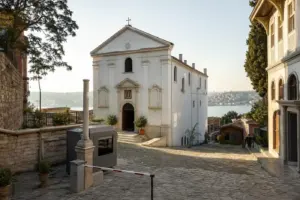 St. George's Cathedral – about 450 m away (~7 min walk) · typical visit: 30–45 minutesOpen daily 08:00–16:30
Main image: AI-generated illustration. It may not show the place exactly as it looks.
 Bulgarian St. Stephen Church – about 800 m away (~13 min walk) · typical visit: 30–45 minutesOpen daily 09:00–17:00
Main image: AI-generated illustration. It may not show the place exactly as it looks.
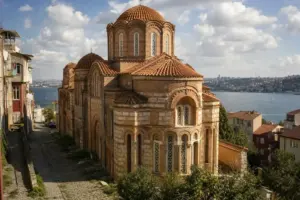 Pantocrator Church – about 800 m away (~13 min walk) · typical visit: 1–2 hours14 min on foot from Vezneciler metro, Open daily 08:00–18:00
Main image: AI-generated illustration. It may not show the place exactly as it looks.
Metro stations near Gül Mosque
 Haliç – about 1000 m away (~16 min walk)Open daily 06:06–00:06
Main image: AI-generated illustration. It may not show the place exactly as it looks.
Restaurants and cafes near Gül Mosque
 Vefa Bozacısı – about 1.4 km away (~23 min walk)7 min on foot from Vezneciler metro, Open daily 08:00–00:00
Main image: AI-generated illustration. It may not show the place exactly as it looks.
 Aheste – about 1.4 km away (~23 min walk)2 min on foot from Tünel metro, Open daily 18:00–00:00
Main image: AI-generated illustration. It may not show the place exactly as it looks.
 Ali Ocakbaşı Karaköy – about 1.5 km away (~24 min walk)8 min on foot from Haliç metro, Open daily 12:00–23:00
Main image: AI-generated illustration. It may not show the place exactly as it looks.
 Neolokal – about 1.5 km away (~24 min walk)7 min on foot from Şişhane metro
Main image: AI-generated illustration. It may not show the place exactly as it looks.
Nightlife near Gül Mosque
 Suma Han – about 1.3 km away (~21 min walk)5 min on foot from Şişhane metro
Main image: AI-generated illustration. It may not show the place exactly as it looks.
 Nardis Jazz Club – about 1.5 km away (~24 min walk)5 min on foot from Şişhane metro, Open 20:30–01:00, closed Sun
Main image: AI-generated illustration. It may not show the place exactly as it looks.
Train stations and river piers near Gül Mosque
 Eminönü Ferry Terminalabout 1.6 km away (~27 min walk)
Main image: AI-generated illustration. It may not show the place exactly as it looks.
 Karaköy Ferry Terminalabout 1.8 km away (~29 min walk)
Main image: AI-generated illustration. It may not show the place exactly as it looks.
Related guides
 Balat and Fener Heritage Walk: Colored Houses and Orthodox Istanbul
Main image: AI-generated illustration. It may not show the place exactly as it looks.
 Golden Horn Waterfront Walk: Waterfront Route Through Fener, Balat & Eyüp
Main image: AI-generated illustration. It may not show the place exactly as it looks.
 Best Underground Cisterns in Istanbul: Three Sites Compared
Main image: AI-generated illustration. It may not show the place exactly as it looks.
 The Red School in Fener: A Castle above the Golden Horn
Main image: AI-generated illustration. It may not show the place exactly as it looks.
 Orient Occident Hotel: Green and Brass in Sirkeci
Main image: AI-generated illustration. It may not show the place exactly as it looks.
Browse more: More in Fatih · All Landmarks · All Sightseeing
FAQ: Gül Mosque
Is the Gül Mosque the same as the Church of Saint Theodosia?
The dedication and the date of its construction are now disputed by scholars. The building was originally a Byzantine church, possibly dedicated to Saint Theodosia, but the exact original name is uncertain. It is now a functioning mosque, though it retained the name Gül (Rose) after the Ottoman conversion.
When was the mosque converted from a church?
After the conquest of Istanbul the church was converted into a mosque in 1499. Some sources cite 1490. The exact year is debated among historians, but the conversion happened within the first 40 years after 1453.
Why is it called the Rose Mosque?
Two traditions exist. One claims the church was decorated with roses on May 29, 1453—the feast day of Saint Theodosia and the day the city fell—and Ottomans named it the Rose Mosque. Another attributes the name to Gül Baba, a Muslim saint whose grave is said to be inside the southern pier. The true origin is disputed.
Is there an entrance fee?
No, entry is completely free. The mosque is a working religious site, not a museum, and welcomes respectful visitors outside of prayer times.
When is it closed due to prayers?
The mosque closes briefly during the five daily prayer times: dawn, noon, afternoon, sunset, and evening. Times vary throughout the year based on the sun. Ask the caretaker or check locally before arriving. Friday midday prayers often attract more worshippers and may restrict tourist access for 1–2 hours.
What should I wear?
Dress modestly: cover your shoulders and knees. Women should bring or wear a headscarf to cover their hair. Remove your shoes before entering the prayer hall. The interior is cool, so a light layer is useful even in summer.
Is the Gül Mosque easy to find?
It is not prominently signed and is located in a quiet residential neighborhood away from the main tourist areas. Use the address (Yavuz Sultan Selim, Vakıf Mektebi Sokak No. 16) with a taxi or ride-share app. By foot, ask locals for "Gül Camii." It takes effort to reach, but that is part of its charm.
What is special about the architecture?
Together with Eski Imaret and Vefa Kilise Mosques, it is one of the most important cross-in-square churches in Istanbul. The dome and galleries are Byzantine in form, while Ottoman repairs added flat-domed sections and new windows. It represents a rare fusion of two architectural traditions.
Istanbul Vibes is a one-person project. A coffee keeps it going
Hotels near Gül Mosque
- Yılmazlar Hotel (50 m) Check prices (affiliate link, opens in a new tab)
- Lotus Hotel Istanbul (50 m) Check prices (affiliate link, opens in a new tab)
- İslamoğlu Hotel (100 m) Check prices (affiliate link, opens in a new tab)
- GEN PLUS HÔTEL (200 m) Check prices (affiliate link, opens in a new tab)
Affiliate link (opens the booking site): we may earn a commission at no extra cost to you.
Restaurants near Gül Mosque
- Rize Odun Ekmeği (50 m) Google Maps
- Gökkuşağı Meze Ve Ev Yemekler (50 m) Google Maps
- Hasan Usta (50 m) Google Maps
- Cibali Vasilis Balıkçısı (100 m) Google Maps
Distances are straight-line, from OpenStreetMap data.

Take this guide with you
Get a free PDF of this guide to print or read offline: key facts, tips and a map link on a few clean pages.
Report an issue on this page
How we research and update our guides
About this guide: AI assistance and accuracy
This guide is created with the help of AI and is based on official sources where available. Mistakes can still happen. Opening hours, prices, rules and other details are given to the best of our knowledge as of the date shown and can change without notice. It offers general recommendations only, not professional, legal or travel advice. Please confirm important details with the official source before you travel; you are responsible for your own plans and decisions.
* Affiliate link: as an Amazon Associate we earn from qualifying purchases at no extra cost to you.
