

The Süleymaniye Mosque is Mimar Sinan’s crowning architectural work in Istanbul, built between 1550 and 1557 for Sultan Süleyman the Magnificent at the height of Ottoman power. Standing on the Third Hill of the historical peninsula, it commands one of the city’s most extensive views across the Golden Horn, Bosphorus, and Sea of Marmara.
Unlike the nearby Blue Mosque in Sultanahmet, Süleymaniye is quieter, far less crowded, and remains an active mosque where visitors walk among worshippers. Entry is free, there are no queues or ticketing theater, and the sense of the place—the light falling through its windows, the echo of footsteps on marble, the afternoon terrace glow—survives intact.
Quick Facts
| Built / opened | 1557 |
|---|---|
| Architect(s) | Mimar Sinan |
| Address | Prof. Sıddık Sami Onar Caddesi No. 1, Fatih, Istanbul Google MapsApple MapsYandex Maps |
| District | Fatih |
| Metro | Vezneciler (M2, Follow signs toward the mosque, then walk uphill approximately 10 minutes) Eminönü (T1, Cross toward the north shore, then walk uphill approximately 10 minutes) |
| Opening hours | Daily 08:30–18:30; Fri 14:30–18:30 Closed to visitors during five daily prayer times (approximately 30 minutes each). Check current prayer times before visiting. |
| Admission | free |
| Best time to visit | Best season: Spring (April–May) and autumn (September–October) offer ideal conditions: mild temperatures, clear light, and comfortable climbing the hill. Winter (December–February) is quieter but can be cold and wet. Summer (June–August) is very hot, especially on the exposed hilltop; morning visits (before 10 AM) are more pleasant.Best time of day: Early morning (8:30–9:30 AM) is ideal for photography and a meditative atmosphere with few other visitors. Mid-day (11:00 AM–2:00 PM) brings the most crowds, especially tourists between visits to other landmarks. Late afternoon (3:30–5:30 PM) offers dramatic light on the dome and terrace, with fewer tourists than midday.Days to avoid: Friday is traditionally the busiest, particularly around noon when the large congregational prayer occurs (tourists are closed out 12:00–1:30 PM). If you wish to see the main hall during peak use, afternoon visits Wednesday–Thursday are less disrupted. Ramadan (date changes yearly) brings evening crowds and altered schedules.Prayer times: Prayer closures are brief (30 minutes) but occur five times daily. The easiest workaround is to check the day's prayer schedule before visiting and arrive just after a prayer ends. |
| Website | suleymaniyecamii.org |
What Is (and Isn't) Part of a Visit to Süleymaniye Mosque?
| Part | Status | Notes |
|---|---|---|
| Main prayer hall (mosque interior) | Included in the standard ticket | Free entry; part of the standard visit. Closed temporarily during five daily prayers. |
| Outer and inner courtyards | Included in the standard ticket | Freely accessible as part of the complex; offer views, fountains, and shaded areas. |
| Gardens and terraces | Included in the standard ticket | All surrounding gardens, including the terrace overlooking the Golden Horn, are part of the complex and free to explore. |
| Tomb of Süleyman the Magnificent (Türbe) | Included in the standard ticket | Included in the complex; sometimes closed during prayers or restoration. Modest dress required. |
| Tomb of Mimar Sinan | Included in the standard ticket | Small octagonal building in the southeastern gardens; included and free. |
| Süleymaniye Hamam (bathhouse) | Separate ticket or institution | Historic bath built by Sinan in 1557 as part of the original complex; now operates as a working hammam with separate entrance and fee. |
| Library and small museum | Separate ticket or institution | The original library building sometimes hosts small exhibitions or collections; verify current access at the mosque entrance. |
| Blue Mosque (Sultanahmet Mosque) | Outside / not part of it | A separate major mosque in nearby Sultanahmet district, approximately 15 minutes' walk south. Not part of Süleymaniye. |
| Hagia Sophia | Outside / not part of it | Another major Istanbul landmark in Sultanahmet district, approximately 20 minutes' walk south and southeast. Not part of Süleymaniye. |
Why Visit Süleymaniye Mosque?
Sinan’s architectural vision makes this mosque essential: the soaring main dome (53 meters high), supported by two half-domes and a system of proportions borrowed from Hagia Sophia, creates an interior of remarkable harmony. The decoration is restrained compared to other Ottoman mosques—plaster, ceramic tile, and stained glass rather than overwhelming ornament—which lets the architecture breathe. Visitors see clay acoustic cylinders embedded between pillars for sound control, a technical detail that remains visible.
The terrace and gardens offer unobstructed views no other Istanbul mosque provides, and the complex surrounding the mosque—its library, hammam, madrasas, and the tombs of Süleyman and Sinan himself—tells the story of Ottoman social architecture in a single hilltop.
How Süleymaniye Mosque Is Laid Out
The Süleymaniye complex spreads across the hilltop as a coordinated ensemble. The main mosque occupies the center, with a large outer courtyard enclosed by colonnades where visitors arrive. The inner courtyard connects directly to the prayer hall. Surrounding the complex are secondary structures: the Süleymaniye Hamam (bathhouse) sits to the west, still operating as a working bath; the library (now a small museum) lies to the east; and four madrasas occupy corners of the grounds.
Tombs dot the gardens—Süleyman’s türbe stands prominently near the mosque, as does the octagonal tomb of his architect, Sinan. Multiple entrances serve the complex: the main gate from Prof. Sıddık Sami Onar Street opens into the outer courtyard; secondary gates lead directly into gardens and courtyards. Walking the entire perimeter takes 15–20 minutes and rewards you with views of the dome from different angles and access to quieter garden areas.
Highlights of Süleymaniye Mosque
The Main Dome
The central dome rises 53 meters high and spans 27.5 meters in diameter—nearly identical to the Blue Mosque, but its effect is different. Four massive supporting pillars carry the weight, with two half-domes behind and geometric shield walls at the sides, a system Sinan adapted from Hagia Sophia. Morning and afternoon light hits the dome's interior surfaces in waves, sculpting the space. Look up from the center to see the dome floating seemingly unsupported above the floor.
Tip: Visit mid-morning (around 9:30) when light streams from the eastern windows and illuminates the dome's surface without harsh shadows.
The Four Minarets
Four slender minarets rise from the corners of the complex—two taller (76 meters) and two shorter (56 meters)—a symbolic arrangement that historians say represents Süleyman as the fourth sultan following Constantinople's conquest and the tenth sultan of the Ottoman line. The taller pair have three balconies each, the shorter two have two balconies each. The proportional relationship between tower and dome is one of Sinan's most studied technical achievements.
Tip: Step back from the outer courtyard to photograph the minarets against the sky. They frame the dome dramatically from the west and south-facing approaches.
The Acoustic System
Between the massive pillars supporting the dome, Sinan embedded more than 60 clay cylinders (earthenware jars) positioned to absorb and distribute sound evenly throughout the prayer hall. This engineering solution is visible if you look between the pillars at mid-height. The result is phenomenal acoustics—voices project clearly without harsh echoes, a critical requirement for Qur'anic recitation and the call to prayer.
Tip: Listen carefully when the imam or muezzin speaks; the clarity will reveal Sinan's acoustic design in action. Clap softly to hear how sound carries.
Windows and Interior Light
The mosque contains more than 200 stained-glass windows (some modern replacements) that cast colored light across the interior. Unlike the Blue Mosque's dense decoration, these windows are the main interior adornment, creating an ever-changing pattern of light on the marble floors and pillars as the sun moves through the day. Many original windows feature intricate geometric patterns and calligraphy by Hasan Çelebi, the master calligrapher of the complex.
Tip: Spend 20 minutes sitting near different windows as light conditions shift. The southeast corner at mid-morning offers particularly rich colored light on the floor.
Sinan's Tomb (Türbe of Mimar Sinan)
Octagonal and modest compared to Süleyman's grand mausoleum, Sinan's tomb sits in the southeastern gardens. The architect is buried here, and the simplicity of his tomb—standing near but not equal to the sultan he served—reflects both Sinan's professional status and the Ottoman principle that the patron outranks even the greatest craftsman. Completed in 1557, it remains one of the major architectural monuments designed by Sinan.
Tip: The tomb is easy to overlook. Walk the eastern and southern edges of the complex to find it; its modest scale and garden setting offer a quiet moment away from the main prayer hall.
Süleyman's Mausoleum (Türbe of Sultan Suleiman)
The sultan's tomb occupies a prominent domed structure in the gardens northwest of the mosque. Built shortly after his death in 1566, its interior walls are covered in çini (ceramic tile) in blues and turquoise, a sharp contrast to the mosque's restrained palette. The octagonal chamber contains the cenotaph; Süleyman's actual burial chamber lies beneath. Access is sometimes limited during prayers or restoration work.
Tip: This building requires a separate visit and a modest dress code (as for the mosque). It is occasionally closed; check at the main entrance before climbing the garden stairs to reach it.
The Outer Courtyard and Colonnades
The courtyard forms a ceremonial forecourt surrounded by slender columns supporting a covered walkway. Arches frame the view toward the mosque entrance, creating a processional rhythm. The courtyard remains open to the sky and is used for overflow prayer spaces on crowded days. Fountains sit in the center, and the scale of the space—nearly 216 meters long and 144 meters wide—gives a sense of the complex's grandeur.
Tip: Enter the courtyard early in the morning before crowds; the light on the columns is clearest at this hour, and you can move slowly through the space without navigating around worshippers.
The Terrace and Golden Horn Views
The northern edge of the complex opens onto a terrace overlooking the Golden Horn with sweeping views toward Galata, the Bosphorus, and the Asian shore. This is the best free vantage point in Istanbul for panoramic photography. The mosque itself frames the view perfectly, and no admission fee or crowded viewing platform blocks access. Late afternoon and early evening light here is particularly rich.
Tip: Bring a camera or phone with good zoom. The vista is essentially unchanged since Sinan's time, making this one of Istanbul's most authentic viewpoints for understanding the city's geography.
Atmosphere
The mosque fills with soft, colored light from its stained-glass windows that shifts throughout the day. The interior is quieter than the Blue Mosque—fewer tour groups, less echoing chatter—with a genuine working rhythm of regular prayers five times daily. Worshippers move in and out, shoes are left at the entrance, and the click of heels on marble and the whisper of prayer create an atmosphere of spiritual use rather than pure tourism.
Early morning (8:30–9:30) feels almost meditative; light angles from the east, the dome seems to float, and few other visitors are present. Mid-day (11:00–14:00) brings more foot traffic, especially Friday afternoons when large congregations gather (the mosque closes to tourists during Friday noon prayer). Late afternoon offers dramatic light and fewer crowds again. The gardens feel peaceful year-round, with terraces overlooking the city and the hum of Istanbul below the hill.
History of Süleymaniye Mosque
Sultan Süleyman the Magnificent commissioned the mosque at the zenith of Ottoman power, in 1550, during the empire’s most stable and militarily dominant era. He was the empire’s longest-reigning sultan (1520–1566), celebrated as a lawgiver and administrator who had just consolidated vast territories from Baghdad to Hungary. A mosque bearing his name was not merely a place of prayer; it was a statement of power and piety, designed to outlast empires.
Mimar Sinan, then in his sixties and already the chief imperial architect for three decades, received the commission. Sinan had built the Şehzade Mosque (1548) as his apprenticeship and would later build the Selimiye in Edirne (1575), which he himself ranked as his masterwork. The Süleymaniye, completed in seven years (1550–1557), he called his journeyman piece—a label that understates its achievement. Construction involved thousands of workers and vast imperial resources at a moment when the empire was confident in its future.
The architectural plan drew inspiration from Hagia Sophia, the Byzantine cathedral Sinan had studied and admired. Like Hagia Sophia, the Süleymaniye uses a main dome supported by two half-domes, creating a unified interior space under a seemingly unsupported vault. But Sinan’s dome is smaller and more proportionally refined than Hagia Sophia’s; the supporting pillars are more slender; the balance of weight and void is more engineered. Historians see in this design Sinan’s mature technical confidence—the geometric and structural principles of classical Ottoman architecture at their height.
The complex was never intended as a mosque alone. The original structure (known as a külliye) included a hospital, library, four theological schools (madrasas), a medical school, a hamam (bathhouse), a caravanserai (inn), a soup kitchen, and formal gardens. By 1559, these ancillary buildings were substantially complete. The ensemble represented the Ottoman ideal of a patron’s social contribution: a single benefactor (the sultan) funded not just prayer space but education, healing, and hospitality for the entire city.
The mosque survived earthquakes that would have toppled lesser structures—engineers note that despite more than a hundred earthquakes in Istanbul since 1557, the walls show no cracks. It was damaged in a fire in the 18th century but was restored. In the 20th century, particularly in the mid-1900s, parts of the complex fell into disrepair. A major restoration campaign ran from 2007 to 2010, funded by Turkish and international donors, returning the mosque to public use and repairing structural elements while preserving original details.
Today, the Süleymaniye remains a working mosque, unlike Hagia Sophia or the Blue Mosque, which are primarily tourist attractions. It continues to serve the surrounding neighborhoods as a place of daily worship, while its architectural authority and hilltop presence have made it one of Istanbul’s most recognized landmarks in both the cityscape and global architecture historical discussions.
Legends and Myths about Süleymaniye Mosque
Sinan's Self-Ranking
Disputed by historians. Sinan is said to have ranked his own three major masterpieces according to his skill level: the Şehzade Mosque (1548) as his apprenticeship, the Süleymaniye as his journeyman work, and the Selimiye in Edirne (1575) as his true masterpiece. The tradition comes through his biographer's account, though historical verification of Sinan's exact words is uncertain. If true, the classification is striking—calling Süleymaniye a "journeyman piece" suggests Sinan believed himself to have improved further.
The Four Minarets' Symbolism
Disputed by historians. The four minarets of different heights are said to symbolize Süleyman's position as the fourth sultan following the conquest of Constantinople and the tenth sultan of the Ottoman Empire. The two taller minarets (76 meters, three balconies each) represent his double significance, while the two shorter ones (56 meters, two balconies each) mark a secondary rank. This symbolic numerology appears in many Ottoman descriptions of the complex, though architectural historians debate whether Sinan consciously encoded this or if the explanation arose later.
Tickets and Booking for Süleymaniye Mosque
Entry is completely free. There is no ticket office, no advance booking, and no queue system. Visitors simply walk in during opening hours (outside prayer times). A donation box sits near the entrance; donations are optional and go toward maintenance of the historic complex.
What counts as a prayer time? The mosque closes to non-worshippers during the five daily Muslim prayers (dawn, mid-morning, noon, mid-afternoon, and evening). Each closure lasts approximately 30 minutes, though Friday’s midday prayer (around noon to 1:30 PM) is longer and accommodates large congregations. Prayer times shift by roughly one hour each month as the sun’s timing changes seasonally.
How to check prayer times: The official Turkish Presidency of Religious Affairs (Diyanet) publishes daily prayer times. Check the Namaz Vakti app or the Diyanet website before your visit to plan your arrival around prayer closures. Staff at the mosque entrance can also tell you when the next prayer will occur.
Photography: Photography is permitted outside prayer times. Flash, tripods, and drones are prohibited inside the mosque; use natural light. No permission is required from staff.
Dress code: Modest clothing is required. Women should cover shoulders and legs and carry a headscarf (you may borrow one from staff if needed). Men should wear long trousers and a shirt. Shoes must be removed inside the mosque; shoe bags are available.
Concessions and Turkish citizens: Entry rates differ for Turkish citizens and residents; see the official website at suleymaniyecamii.org for all categories.
Suggested itineraries Süleymaniye Mosque
1 hour
Enter via the main gate, walk through the outer courtyard to view the entrance portico and minarets, then step into the prayer hall. Spend 15–20 minutes observing the dome, the pillars, and the window light. Exit through the courtyard and climb to the northern terrace for 10 minutes of views over the Golden Horn. Quick visit; best done outside prayer times on a clear day.
1.5–2 hours
Begin at the main entrance, tour the outer courtyard and its colonnades slowly. Enter the prayer hall and spend 30 minutes observing the dome, light, and acoustics from different positions. Exit and walk to the inner courtyard, then explore the gardens, locating Süleyman's türbe and Sinan's modest octagonal tomb. End on the terrace at sunset (or golden hour) for final photographs. Allows for reflection and a slower pace.
2–3 hours
Spend a full morning or afternoon at leisure. Explore the entire complex: outer courtyard, prayer hall with sustained observation of the dome and light at different times, inner courtyard, gardens with both türbes, and the terrace. Visit the Süleymaniye Hamam entrance area (the bath itself is a separate, fee-based facility). Check the library/museum building if open. Sit on terraces and benches. Ideal for photographers and those interested in Ottoman social architecture.
How to Get to Süleymaniye Mosque
By Metro: Take the M2 line (Yenikapi–Hacıosman) to Vezneciler station. Exit and follow signs toward the mosque. From the station, walk uphill for approximately 8–10 minutes via narrow streets. The route is steep but straightforward; several restaurants and shops mark the way.
By Tram: Take the T1 line (Bağcılar–Kabataş) to Eminönü, Beyazıt, or Laleli–Üniversite stops. From any of these, walk north and uphill toward the hilltop. Eminönü to the mosque takes approximately 10–15 minutes on foot; the route follows Prof. Sıddık Sami Onar Street northward.
Walking from Sultanahmet: If visiting the Blue Mosque and Hagia Sophia first, Süleymaniye is reachable on foot in approximately 15–20 minutes. Head north from Sultanahmet toward the Grand Bazaar district, then climb toward the hilltop. The Grand Bazaar area sits just south of the mosque complex.
By taxi or private car: Less practical due to the hilltop location and narrow surrounding streets. If arriving by car, drop off on Prof. Sıddık Sami Onar Street and walk the final 2–5 minutes.
Accessibility note: The complex sits on a hill with multiple steep staircases. Wheelchair access to the main prayer hall is very limited. The outer courtyards are more accessible but still involve slopes and steps.
Accessibility
Wheelchair access: The main prayer hall itself is not wheelchair accessible due to elevated entrance steps and the interior layout designed for standing and kneeling prayer. The outer courtyards are partially accessible but involve slopes and steps. Visitors with mobility challenges should plan for the helper to manage stairs; one companion is typically allowed to accompany visitors who need assistance.Lifts and ramps: No elevators or ramps serve the main building. Secondary entrance gates to courtyards exist, but none are formally adapted for wheelchairs.Accessible facilities: Restroom facilities are available; check with staff at the entrance for their location. Seating benches are scattered through the gardens and courtyards.Service animals: Guide dogs are typically not permitted inside the prayer hall due to Islamic cleanliness rules, but staff can advise on workarounds or prayer hall alternatives for visitors with visual impairments.Age and physical fitness: The climb up the hill and multiple stairs within the complex require moderate fitness. Elderly visitors and those with knee or leg problems should allow extra time and take breaks on benches throughout the gardens.
Food Nearby
The streets surrounding the mosque, especially Prof. Sıddık Sami Onar Caddesi and the approaches from Vezneciler, are lined with informal restaurants and kebab shops popular with local workers and students rather than tourists. These offer authentic, affordable Turkish fare—kebabs, lentil soup, meze—at budget prices.Near the mosque entrance, several tea gardens and café-restaurants serve tea, coffee, and light snacks with views over the Golden Horn. These are quieter than the crowded tourist restaurants in Sultanahmet and offer a local atmosphere.The Grand Bazaar (15-minute walk downhill) has numerous lunch spots, though many are tourist-oriented. For a more local experience, eat in the neighborhoods immediately around the mosque before heading to the bazaar. No major international chains operate directly adjacent to the complex.
What to Bring
Wear comfortable walking shoes suitable for climbing stairs; the ascent is steep and sustained. Bring a light scarf or headcover if you don't have one; the mosque provides loaners, but your own is more hygienic and avoids delays. A camera or phone with a good zoom lens captures the terrace views and dome details. Sunscreen and a hat are essential in summer; the hill offers little shade. Water bottle recommended, especially in hot months. Modest clothing that covers shoulders and legs is required; plan your outfit accordingly. An app for checking that day's prayer times (Namaz Vakti or Diyanet) prevents arrival during closures. Secure bag required by security (see rules below); avoid large backpacks if possible.
Best Views and Photo Spots of Süleymaniye Mosque
The northern terrace (overlooking the Golden Horn)
Unobstructed vista toward Galata, the Bosphorus, and the Asian shore. The mosque dome frames the left side of the view. Ideal for wide landscape shots and the city's most authentic panoramic perspective without ticketed viewing platforms.
Best time: Late afternoon (4:00–5:30 PM) for warm golden light on the water and city buildings; early morning (8:30–9:00 AM) for clarity and cool tones.
Outer courtyard, looking north toward the mosque entrance
The four minarets frame the central dome perfectly, with colonnades on either side creating depth. The symmetry and proportions reveal Sinan's design in full measure. Foreground fountains and marble paving add foreground interest.
Best time: Mid-morning (9:00–11:00 AM) when eastern light strikes the dome and shadows from colonnades define depth; golden hour (5:00–6:00 PM) for warm tones on minarets.
Interior dome viewed from near the center of the prayer hall
The 53-meter dome appears to float above supporting pillars and half-domes. Light from stained-glass windows casts colored patterns on the dome interior. The scale and engineering dominate the frame. Shoot upward into the dome against the light for silhouette details.
Best time: Mid-to-late morning (9:30–11:30 AM) when light streams from eastern windows; late afternoon (4:00–5:00 PM) for warm interior light and different shadow patterns.
Southern approach from the Grand Bazaar side
Climbing through narrow streets toward the hilltop, the dome and minarets suddenly appear above rooflines, framed by centuries-old buildings. This offers a perspective similar to how Ottoman-era residents would have first viewed the complex from the lower city.
Best time: Morning (before 10:00 AM) or late afternoon (after 4:00 PM) when shadows and light angle through narrow streets dynamically.
The octagonal tomb of Mimar Sinan (southeastern gardens)
Modest by Ottoman standards, the domed structure sits quietly in landscaped gardens. The simplicity and garden setting—near but not equal to Süleyman's grander türbe—convey Sinan's professional position. Easy to overlook; rewards a deliberately composed photograph.
Best time: Golden hour (5:00–6:00 PM) when the dome's surface catches warm light and gardens offer soft shadows.
Stained-glass windows illuminated from within the prayer hall
Geometric and calligraphic patterns in colored glass cast colored light onto marble floors and pillars. The interplay of light and shadow shifts throughout the day. Close-ups reveal intricate details; wider shots show the cascading pattern across the prayer hall floor.
Best time: Mid-morning to early afternoon (9:00 AM–3:00 PM) when sun angle is high and colors are most vivid. Midday (11:00 AM–1:00 PM) produces the most saturated color on the floor.
Photography Rules
Photography is permitted outside prayer times and in all courtyards and gardens. Flash, tripods, and drones are prohibited inside the prayer hall. Natural light is excellent: eastern light in early morning, southern light at midday, and western light in late afternoon. The dome interior and stained-glass windows offer the most compelling interior subjects. The terrace and gardens provide expansive views with the city as backdrop. Respect worshippers and do not photograph people during prayer. Modest bag policy applies (no oversized backpacks; security may inspect).
Family Suitability
The mosque is family-friendly for visitors aged 8 and up who can manage stairs and respect the working prayer space. Younger children may find the large interior scale and long visit less engaging. Stroller access is poor due to stairs inside the complex and steep hill approaches; parents should plan to carry small children or arrange a taxi drop-off. The gardens offer shaded rest areas and are more suitable for small kids than the interior prayer hall. Prayer-time closures (brief, 30 minutes) work well for families—use these as rest breaks. Dress code applies to children as well: modest clothing required, headscarves for girls. The terrace and gardens are peaceful for families and offer an excellent spot for a snack or picnic lunch (if local rules permit). Avoid midday hours when crowds peak and heat is intense.
Istanbul Vibes Tips
- Check the day's prayer times before arriving. Use the Namaz Vakti app or the Diyanet (Presidency of Religious Affairs) website. Arriving just after a prayer ends means you'll have 25–30 minutes of uninterrupted viewing before the next prayer and closure. This simple step saves frustration and maximizes your time inside the prayer hall.
- Arrive early (8:30–9:00 AM) if photography is your priority. Morning light from the east fills the prayer hall softly, illuminating the dome and stained-glass windows without harsh shadows. By 11:00 AM, tour groups and midday worshippers increase noise and foot traffic. One hour early beats three hours at midday.
- Explore the gardens and the terraces thoroughly; many visitors rush through the main prayer hall and miss the complex's full scope. The tomb of Mimar Sinan in the southeast gardens and the northern terrace overlook the Golden Horn are as much part of Sinan's achievement as the dome. Allow time to wander.
- Do not buy tickets from anyone outside the mosque. Entry is completely free; people selling "tickets" at the gates are running a common scam. Walk straight in. If questioned, ask for the main information desk inside.
- Sit inside the prayer hall for at least 10–15 minutes after entering. Let your eyes adjust to the light and your mind adjust to the scale. The dome seems to reveal itself gradually; rushed visitors miss this architecture's full impact. Sitting on the carpeted floor is permitted; remove shoes at the entrance.
- Visit the terrace at sunset (or golden hour, 30–45 minutes before sunset) for the best photographs and the fewest crowds. The light on the Golden Horn and distant hills is unmatched, and the temperature cools as the day ends.
Explore Nearby Süleymaniye Mosque
Sights near Süleymaniye Mosque
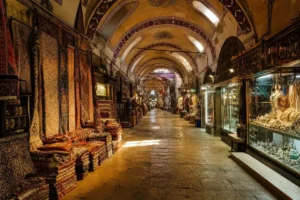 Grand Bazaar – about 700 m away (~11 min walk) · typical visit: 2–4 hours4 min on foot from Beyazıt-Kapalıçarşı metro, Open 08:30–19:00, closed Sun
Main image: AI-generated illustration. It may not show the place exactly as it looks.
 Blue Mosque – about 1.6 km away (~26 min walk) · typical visit: 45–75 minutes3 min on foot from Gülhane metro
Main image: AI-generated illustration. It may not show the place exactly as it looks.
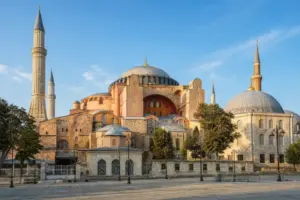 Hagia Sophia – about 1.6 km away (~26 min walk) · typical visit: 1–1.5 hours8 min on foot from Gülhane metro, Open daily 09:00–19:30
Main image: AI-generated illustration. It may not show the place exactly as it looks.
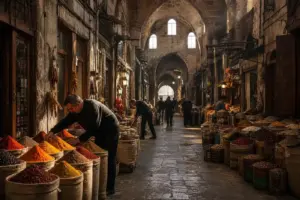 Spice Bazaar – about 550 m away (~9 min walk) · typical visit: 1–2 hours13 min on foot from Haliç metro, Open daily 08:00–19:30
Main image: AI-generated illustration. It may not show the place exactly as it looks.
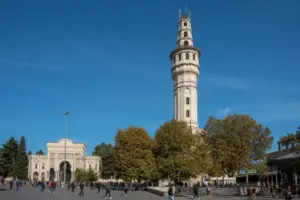 Beyazit Tower – about 400 m away (~6 min walk) · typical visit: 20–30 minutes (viewing from outside)7 min on foot from Vezneciler metro
Main image: AI-generated illustration. It may not show the place exactly as it looks.
 Rüstem Pasha Mosque – about 450 m away (~7 min walk) · typical visit: 45 minutes to 1 hour10 min on foot from Haliç metro, Open daily 09:00–18:00
Main image: AI-generated illustration. It may not show the place exactly as it looks.
Metro stations near Süleymaniye Mosque
 Vezneciler – about 550 m away (~9 min walk)Open daily 05:59–00:24
Main image: AI-generated illustration. It may not show the place exactly as it looks.
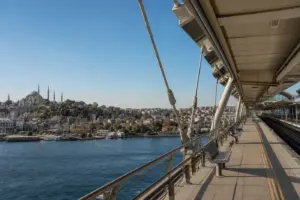 Haliç – about 800 m away (~13 min walk)Open daily 06:06–00:06
Main image: AI-generated illustration. It may not show the place exactly as it looks.
 Laleli-Üniversiteabout 800 m away (~13 min walk)
Main image: AI-generated illustration. It may not show the place exactly as it looks.
Restaurants and cafes near Süleymaniye Mosque
 Vefa Bozacısı – about 150 m away (~2 min walk)7 min on foot from Vezneciler metro, Open daily 08:00–00:00
Main image: AI-generated illustration. It may not show the place exactly as it looks.
 Pandeli – about 650 m away (~10 min walk)12 min on foot from Haliç metro, Open 11:30–19:00, closed Sun
Main image: AI-generated illustration. It may not show the place exactly as it looks.
 Mivan Restaurant – about 700 m away (~11 min walk)4 min on foot from Vezneciler metro, Open daily 08:30–00:00
Main image: AI-generated illustration. It may not show the place exactly as it looks.
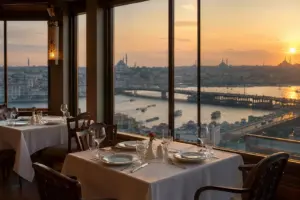 Hamdi Restaurant – about 750 m away (~12 min walk)12 min on foot from Çemberlitaş metro, Open daily 12:00–00:00
Main image: AI-generated illustration. It may not show the place exactly as it looks.
Nightlife near Süleymaniye Mosque
 Cheers Karaköy – about 1000 m away (~16 min walk)9 min on foot from Haliç metro, Open daily 08:30–02:00
Main image: AI-generated illustration. It may not show the place exactly as it looks.
 Suma Han – about 1.2 km away (~19 min walk)5 min on foot from Şişhane metro
Main image: AI-generated illustration. It may not show the place exactly as it looks.
Train stations and river piers near Süleymaniye Mosque
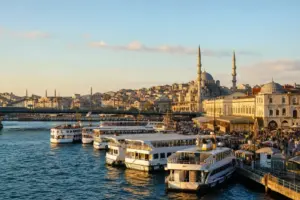 Eminönü Ferry Terminalabout 600 m away (~10 min walk)
Main image: AI-generated illustration. It may not show the place exactly as it looks.
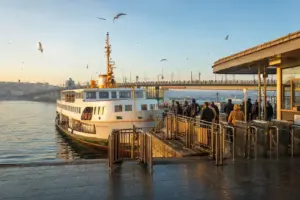 Karaköy Ferry Terminalabout 1.2 km away (~20 min walk)
Main image: AI-generated illustration. It may not show the place exactly as it looks.
Events and traditions near Süleymaniye Mosque
 Istanbul Marathonabout 1.6 km away (~26 min walk)
Main image: AI-generated illustration. It may not show the place exactly as it looks.
Related guides
 Best Hammams in Istanbul: Prices, Services and Comparisons
Main image: AI-generated illustration. It may not show the place exactly as it looks.
 Koska Köftecisi: Köfte and Piyaz in Vefa
Main image: AI-generated illustration. It may not show the place exactly as it looks.
 Şehzade Mosque: Mimar Sinan’s First Imperial Masterpiece4 min on foot from Vezneciler metro
Main image: AI-generated illustration. It may not show the place exactly as it looks.
 Tamarind Sherbet (Demirhindi Şerbeti): Recipe and Ottoman History
Main image: AI-generated illustration. It may not show the place exactly as it looks.
 Free Things to Do in Istanbul: 10 Major Sights and Walks
Main image: AI-generated illustration. It may not show the place exactly as it looks.
Browse more: More in Fatih · All Landmarks · All Sightseeing
FAQ: Süleymaniye Mosque
Is Süleymaniye Mosque free to enter?
Yes, entry is completely free. There is no ticket booth, no advance booking, and no entrance fee. A donation box sits near the entrance; donations are optional and support mosque maintenance. Anyone selling tickets outside is running a scam.
What are the opening hours and when is it closed?
The mosque is open daily from approximately 8:30 AM to 6:45 PM, except during the five daily Muslim prayers (roughly 30 minutes each) when it closes to tourists. Friday's midday prayer (around noon to 1:30 PM) is the longest closure. Prayer times shift monthly with the sun. Check the Namaz Vakti app or Diyanet website for exact times on your visit date.
Can I visit during prayer times?
No. The mosque closes to non-worshippers during the five daily prayers. If you arrive during a prayer closure, you can wait in the courtyards and gardens (free and pleasant) or return in 30–45 minutes. The Friday noon prayer is longer (1–1.5 hours). Plan your visit around prayer schedules using an app.
What should I wear?
Modest clothing is required: cover shoulders, chest, and legs (to the knee at minimum). Women should carry a headscarf; the mosque provides loaners, but your own is more hygienic. Men should wear long trousers and a shirt. Shoes must be removed inside; shoe bags are provided. Children must follow the same dress code.
How long does a visit take?
Plan 1–2 hours for a thorough visit: 30–40 minutes inside the prayer hall observing the dome and light, 20–30 minutes exploring the gardens and terraces, and 10–20 minutes in the courtyards. Photographers and architecture enthusiasts may spend 2–3 hours. A quick visit (prayer hall only) takes 45 minutes.
Is Süleymaniye Mosque the same as the Blue Mosque?
No. Süleymaniye and the Blue Mosque (Sultanahmet Mosque) are two separate major mosques. Süleymaniye sits on a hill in Fatih district; the Blue Mosque is in Sultanahmet, about 15 minutes' walk south. Both are worth visiting. Süleymaniye is quieter, less touristy, and offers superior views of the Golden Horn.
Can I take photographs?
Yes, photography is permitted outside prayer times in all areas (prayer hall, courtyards, gardens, terrace). Flash, tripods, and drones are prohibited inside the prayer hall. Use natural light. Do not photograph worshippers during prayer. No permission from staff is needed.
What is the Süleymaniye complex, and is all of it free?
The complex includes the main mosque, courtyards, gardens, and the tombs of Süleyman and Sinan—all free. The Süleymaniye Hamam (bathhouse) is a separate, fee-based facility with its own entrance. The library building sometimes hosts exhibitions; verify current access at the entrance. All outdoor areas and gardens are included in free admission.
Istanbul Vibes is a one-person project. A coffee keeps it going
Hotels near Süleymaniye Mosque
- Solomon's Mansion Hotel (250 m) Check prices (affiliate link, opens in a new tab)
- Hal hotel (250 m) Check prices (affiliate link, opens in a new tab)
- Tuana Hotel (300 m) Check prices (affiliate link, opens in a new tab)
- Sea star hotel (300 m) Check prices (affiliate link, opens in a new tab)
Affiliate link (opens the booking site): we may earn a commission at no extra cost to you.
Restaurants near Süleymaniye Mosque
- Erzincanlı Ali Baba Restoran (100 m) Google Maps
- Daruzziyafe (150 m) Google Maps
- Daruzziyafe turkish resturant (150 m) Google Maps
- Kösem Sultan (150 m) Google Maps
Distances are straight-line, from OpenStreetMap data.

Take this guide with you
Get a free PDF of this guide to print or read offline: key facts, tips and a map link on a few clean pages.
Report an issue on this page
How we research and update our guides
About this guide: AI assistance and accuracy
This guide is created with the help of AI and is based on official sources where available. Mistakes can still happen. Opening hours, prices, rules and other details are given to the best of our knowledge as of the date shown and can change without notice. It offers general recommendations only, not professional, legal or travel advice. Please confirm important details with the official source before you travel; you are responsible for your own plans and decisions.
* Affiliate link: as an Amazon Associate we earn from qualifying purchases at no extra cost to you.
