
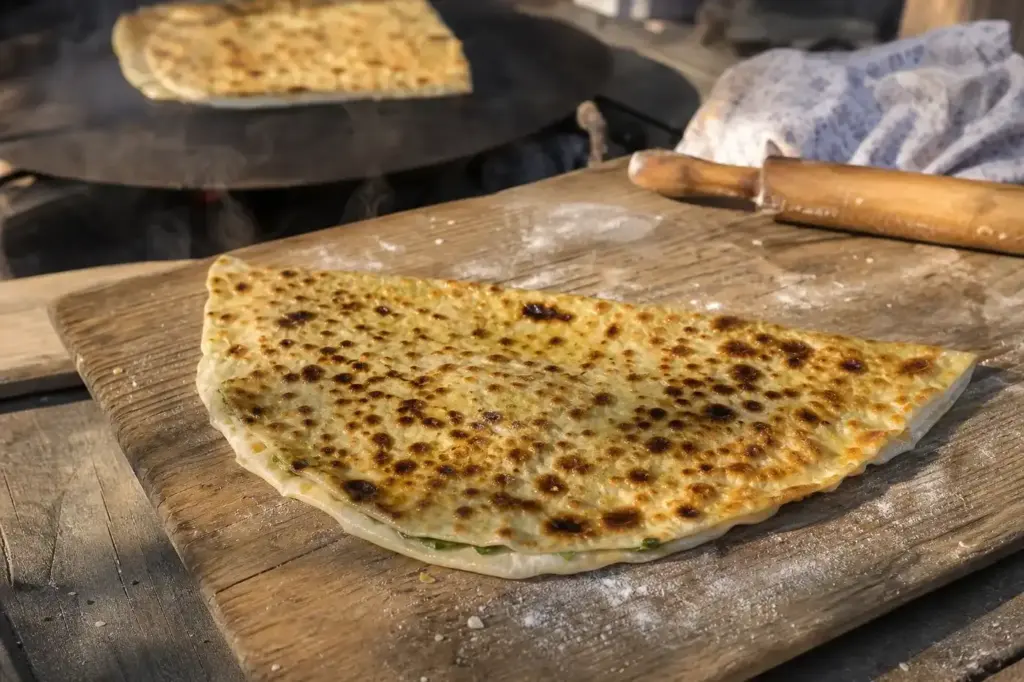
Gözleme is one of Turkey’s most iconic street foods, appearing in markets and at breakfast tables across Istanbul and the rest of the country. If you want to make authentic gözleme at home, this guide walks you through the simple dough, traditional fillings, and cooking method.
The recommended approach is to make the dough from scratch using flour, water, and salt, then roll it paper-thin, fill it with your choice of spinach and cheese (the classic), potato, or minced meat, fold it sealed, and cook it on a hot skillet until golden and blistered. Total time is around 40–50 minutes for 2–4 servings.
Quick answer: Mix flour, water, and salt into a soft dough and let it rest. Roll each portion paper-thin, add filling to one half, fold sealed, and cook on a hot griddle until golden with dark blistered spots. Brush with butter while warm. Serves 2–4 people in about 45 minutes.
At a Glance
| Type | Street food & snacks |
|---|---|
| Origin | Turkish Yörüks (nomads) made gözleme as they traveled from Central Asia and settled in Anatolia, today's Turkey. The oldest record of the word in a Turkic language is dated to 1477. In the early days, it was primarily served for breakfast or as a snack, typically cooked at home by women. Originally a breakfast item or light homemade snack, the comfort food nature of gözleme allowed it to achieve fast-food status in Turkey in the latter part of the twentieth century. |
| Servings | 2–4 people |
| Total time | 40–50 minutes |
| Difficulty | Easy |
History and Story of Gözleme
The word gözleme is derived from the Turkish word közleme, meaning “to grill or cook on the embers”, which ultimately traces back to Turkish word köz, meaning “ember”. An alternative explanation is that “göz” is Turkish for “eye”, referring to the blisters that form on the flatbread as it is griddled. In Istanbul’s street markets, you may see women rolling gözleme dough into thin round sheets effortlessly over wooden boards and cooking them on the wide sac griddle.
Ingredients
- 300 g all-purpose flour
- 200 ml warm water
- 5 g salt
- 15 ml olive oil or vegetable oil
- 250 g spinach and 150 g feta cheese, or 400 g potato with onion, or 300 g minced lamb or beef with spices
- 30 g butter for brushing
- Flour for dusting
How Gözleme Is Made
Step 1: Mix the dough
In a large bowl, combine warm water, salt, and oil. Gradually add the flour, stirring with a spoon until a soft dough forms. Do not add all flour at once; add it slowly until the dough is soft but not sticky. It should feel slightly tacky.
Tip: If the dough becomes too sticky, dust with a little more flour. If too dry, add water a teaspoon at a time.
Step 2: Knead and rest the dough
Turn the dough onto a lightly floured surface and knead gently for 2–3 minutes until smooth. Divide into 4–6 equal portions, shape each into a ball, and cover them with a damp cloth or plastic wrap. Let rest for 20–30 minutes at room temperature so the dough becomes easier to stretch.
Tip: Resting the dough is essential—it makes rolling much easier and prevents the dough from snapping back.
Step 3: Prepare the filling
For spinach and cheese: chop fresh spinach finely (or thaw and squeeze dry if using frozen), mix with crumbled feta and a finely chopped small onion. For potato: boil and mash potatoes, mix with sautéed onion and a pinch of dried mint. For meat: brown minced meat with onion and spices. Season all fillings to taste.
Tip: Keep fillings simple and not too wet; excess moisture will make the flatbread soggy instead of crispy.
Step 4: Roll out the dough
On a well-floured surface, take one dough ball and roll it with a rolling pin into a large, very thin circle about the size of a dinner plate (or larger if you can—the thinner the better). The dough should be almost transparent in places. Dust away excess flour as you go.
Tip: If the dough resists, let it rest for a minute, then continue rolling. Work gently to avoid tearing.
Step 5: Fill and fold
Spread a portion of filling (about 2–3 tablespoons) onto half of the circle in a rectangular strip, leaving a small border at the edges. Fold the empty half over the filling to form a semicircle or rectangle. Press the edges firmly to seal so the filling does not leak during cooking.
Tip: Do not overfill—the gözleme should seal completely. A small amount of filling cooks better and stays sealed.
Step 6: Cook on the griddle
Heat a large non-stick skillet or griddle over medium-high heat until very hot. Place the sealed gözleme on the dry pan (no oil needed in the pan). Cook for 2–3 minutes on the first side until golden with dark brown or slightly charred spots (these spots are traditional, called "eyes"). Flip carefully and cook the second side for another 1–2 minutes until equally golden.
Tip: The spots that form are the signature of gözleme. Do not be afraid of them—that is the traditional appearance and flavor.
Step 7: Finish with butter and serve
Transfer the cooked gözleme to a plate and immediately brush the top side generously with melted butter or a little olive oil while it is still warm. This softens the crust slightly and adds richness. Serve hot, optionally cut into pieces, with Turkish tea, ayran (yoghurt drink), or lemon wedges on the side.
Tip: Serve immediately while warm for the best taste and texture. Gözleme firms up as it cools.
Variants
- Peynirli gözleme (cheese): filled with white feta or Turkish white cheese and fresh herbs like parsley or dill
- Ispanaklı gözleme (spinach and feta): the most popular version across Turkey, combining spinach, feta, and onion
- Patatesli gözleme (potato): boiled potato mixed with onion, sometimes with dried mint
- Kıymalı gözleme (minced meat): ground lamb or beef cooked with onion and spices like cumin and red pepper flakes
- Patlıcanlı gözleme (eggplant): roasted eggplant with cheese, popular in some regions
- Yeşillik gözleme (herbs and greens): a mix of fresh greens—parsley, dill, beetroot leaves, or wild herbs—whatever is in season
- Mixed (karışık) gözleme: potato, cheese, and seasonal herbs combined
Common Mistakes to Avoid
- Rolling the dough too thick: gözleme should be paper-thin so it crisps on the outside while cooking. Thick dough stays chewy and does not develop the traditional golden spots.
- Overfilling: too much filling makes it impossible to seal the edges properly, and the gözleme will split open during cooking, losing filling and texture.
- Using a wet filling: potatoes that are too soft or spinach that is not properly squeezed dry adds moisture to the dough, making it soggy rather than crispy.
- Cooking at too low a temperature: the griddle must be very hot. Low heat produces pale, soft gözleme without the characteristic golden blistered spots.
- Not sealing the edges firmly: loose edges allow steam and filling to escape, and the gözleme falls apart when flipped.
- Using oil or butter in the pan: gözleme cooks best dry on the griddle, then butter is added afterward. Cooking in oil makes it greasy rather than crispy.
How to Order and Eat It
Gözleme is best served warm with yoghurt, ayran, lemon wedges, or Turkish tea. In Turkey, a side of turşu (pickled vegetables) is a traditional accompaniment. If you order yeşillik gözleme, you get a thin, crispy pastry filled with ‘greenery’—anything from chopped herbs such as parsley to salad leaves such as beetroot leaves, the leaves from celeriac or wild radish. The gözleme is typically cut or torn into pieces and eaten by hand. The warm butter-brushed surface should still be slightly flexible so it does not break apart easily.
To order: Gözleme lütfen [Gözleme lutfen]
Diet and Allergens
- Contains gluten (flour dough)
- Contains dairy (cheese, butter)
- Vegetarian option available (spinach and cheese, potato)
- Meat versions available (minced lamb or beef)
Where to Try Gözleme
 Rumeli Kale Cafe & Restaurant Turkish breakfast and grill
Main image: AI-generated illustration. It may not show the place exactly as it looks.
 Cafe Privato Turkish village breakfast, home-style dishes and a few Georgian specialties
Main image: AI-generated illustration. It may not show the place exactly as it looks.
 Vegan Community Kitchen Turkish Vegan
Main image: AI-generated illustration. It may not show the place exactly as it looks.
 Yigit Sofram Turkish Breakfast
Main image: AI-generated illustration. It may not show the place exactly as it looks.
 TURK Fatih Tutak Modern Turkish
Main image: AI-generated illustration. It may not show the place exactly as it looks.
 Ritim12 min on foot from Tünel metro, Open daily 10:00–04:30
Main image: AI-generated illustration. It may not show the place exactly as it looks.
Istanbul Vibes Tips
- In Istanbul's markets (Spice Bazaar, or any morning street market), you will see gözleme stands with a sac griddle and a cook rolling dough by hand. The rolls are so thin they are almost transparent. Buy one hot off the griddle for the most authentic experience—it will be crispier and warmer than anything you buy later.
- If you find spinach gözleme too salty (because of the feta), ask for it with spinach only or with fresh herbs (yeşillik) mixed in. Some vendors will adjust to your preference.
- Gözleme is cheapest in the early morning at local market stalls rather than at tourist spots or restaurants. Buy it from a woman rolling dough, not a packaged version sitting under a heat lamp.
- Potato gözleme is less common in Istanbul city center but more common in rural and Anatolian markets. If you want to try this version, visit a neighborhood market rather than a tourist bazaar.
- Do not attempt to make gözleme with phyllo dough (yufka) instead of fresh dough if you are a beginner—phyllo is much more fragile and requires different handling. Start with a flour-and-water dough, which is more forgiving.
- Gözleme does not keep well once cooked. It is best eaten within an hour while still soft and warm. If you make extras, store them in a cool place wrapped in cloth (not plastic, which traps steam and makes them soggy).
Explore Nearby Gözleme
Related guides
 How to Avoid Restaurant Scams in Istanbul: Prevention and Fair Billing
Main image: AI-generated illustration. It may not show the place exactly as it looks.
 How to Eat Turkish Breakfast: A Step-by-Step Ritual
Main image: AI-generated illustration. It may not show the place exactly as it looks.
 Best Street Food and Markets: Where Istanbul Eats
Main image: AI-generated illustration. It may not show the place exactly as it looks.
Browse more: All Food & Drink · All Other
FAQ
Is gözleme the same as a Turkish pancake?
Often translated as pancake, gözleme is actually a flatbread. It is thinner and crisper than a pancake, more like a savory crepe with a sealed edge. The dough is rolled to paper-thin transparency and cooked on a griddle until blistered, not layered or fluffy like a pancake.
Can I make gözleme without yeast?
The dough is usually unleavened, made only with flour, salt, and water, but gözleme can be made from yeast dough as well. The traditional method uses unleavened dough, which is simpler and requires no rising time.
What is a sac and do I need one?
A sac is a hot, convex metal griddle traditionally placed over an open fire. It is a round and slightly curved griddle that is a little higher at the top than on the sides. In Istanbul, you can use a large non-stick skillet or flat griddle at home—a sac is not essential, though it produces authentic results.
Can gözleme be made in advance?
Gözleme is best eaten fresh and warm. It can be made up to 1 hour ahead and kept wrapped in cloth at room temperature. Do not refrigerate or freeze unbaked dough portions, as the texture changes. For best results, cook it to order.
What are the most popular fillings in Istanbul?
Spinach and feta cheese gözleme (ıspanaklı gözleme) offers a deliciously earthy and tangy flavor profile, while minced meat gözleme (kıymalı gözleme) provides a rich and satisfying experience. In Istanbul, spinach and cheese is the most common; meat versions are more popular in Central Anatolia.
Is gözleme vegetarian?
Many gözleme varieties are vegetarian: spinach and cheese, plain cheese with herbs, potato, and mushroom. Meat versions (lamb or beef) are also common, so always ask or specify if you want a vegetarian version.
What does gözleme contain that might cause allergies?
Gözleme is typically filled with cheese, spinach, potatoes, or ground meat and cooked in a hot skillet. It contains gluten (in the flour dough), dairy (cheese and butter), and may contain eggs. Meat versions may include spices. Always inform vendors of allergies.
Can I visit a gözleme maker in Istanbul and watch it being made?
Gözleme is enjoyed all throughout Turkey, and if you visit, you may see women rolling gözleme dough into thin round sheets effortlessly over wooden boards in street markets and cooking them on the wide sac griddle. Yes—street market stalls in Istanbul (especially morning markets and the Spice Bazaar) have gözleme stands where you can watch the preparation and order fresh.
Istanbul Vibes is a one-person project. A coffee keeps it going

Take this guide with you
Get a free PDF of this guide to print or read offline: key facts, tips and a map link on a few clean pages.
Report an issue on this page
How we research and update our guides
About this guide: AI assistance and accuracy
This guide is created with the help of AI and is based on official sources where available. Mistakes can still happen. Opening hours, prices, rules and other details are given to the best of our knowledge as of the date shown and can change without notice. It offers general recommendations only, not professional, legal or travel advice. Please confirm important details with the official source before you travel; you are responsible for your own plans and decisions.
* Affiliate link: as an Amazon Associate we earn from qualifying purchases at no extra cost to you.
